
Peak Cluster and Morecambe Net Zero: Why CCS Opposition Is Growing in Wirral
Local communities raise multiple concerns about the Peak Cluster years ahead of the construction start.


The heart of the opposition is the Wirral council in North West England, whose area will host a carbon dioxide pipeline and a potential onshore compression facility. Carbon dioxide will be captured from four cement and lime plants in the Peak District and transported to an offshore storage site – the Morecambe Net Zero (MNZ) - operated by Spirit Energy. The partnership between the Peak Cluster carbon capture project and MNZ is seeking to decarbonize 40% of the United Kingdom’s cement and lime industry and permanently store up to 1 Gt of CO2 over the project’s lifetime. Given the potential scale and the alignment with the country’s net zero targets, the entire project enjoys the backing of the current Labour government. However, at the local level the landscape is more complex and challenging, with criticism and opposition crossing party lines.
Local Opposition to CCS: Numbers Are Significant
The scale of the opposition is impressive compared to similar cases elsewhere in the world, although it is yet to be seen whether it translates into a meaningful institutionalized pressure on the project’s developer. The March 2026 protests included hundreds of local residents, while the petition against the Peak Cluster, submitted to the government in London, contained almost 17,000 signatures. However, the Labour government has demonstrated full commitment to the project and rejected the petition, while the project developer has ensured that the relocation of the pipeline and CO2 compression facility will never be an option. Given the circumstances, the situation is likely heading to a standoff between the local stakeholders and the company, increasing the risk of a legal action intended to block the pipeline.
Remarkably, the representatives of all parties – the Labour, Conservative, Liberal Democrats, Greens, and Reform – in the Wirral Council have sided with the protestors. They are also likely to encourage the MPs from Wirral in Westminster to communicate the concerns to the ruling Labour Party and put pressure on the government to stall the construction of the pipeline. As the project is expected to be operational in 2032, it could become a major issue in local or even general elections over the medium term. Still, the Labour and Conservatives are aligned on the role of the carbon capture and storage industry in the country’s industrial decarbonization mix, and any potential change in government is unlikely to have an impact on the Peak Cluster. However, if the opponents pursue a court case against the project, it could prompt additional costs and increase short-term uncertainty.
Trust and CO2 Pipeline Safety Go Hand in Hand
The concerns of local residents in Wirral indicate a poor level of public awareness about the technology and persistent misconceptions that are driving the overall negative attitudes towards the project. Apparently, neither the council nor the residents are satisfied with the way the representatives of the Peak Cluster have communicated with them about the details of the project, which also adds to the unfavourable perception and undermines public trust and confidence.
While the opponents understand the need to decarbonize the UK’s economy and see the risks of climate change, they do not accept carbon capture and storage as a viable solution and call for alternatives. The safety concerns are driven by the perceived risk of a pipeline rupture, and the opponents frequently mention the incident in Satartia, Mississippi (United States) in 2020 as the proof of the technology’s threat to human health and the environment. The proximity of the pipe to residential areas, schools, hospitals, and kindergartens is driving questions about safety precautions, monitoring, regulatory oversight, and emergency response preparedness. Moreover, there are also misconceptions about offshore carbon storage. The massive releases of CO2 from two lakes in Cameroon in the 1980s that killed over 1,700 local residents in total are being used by the campaigners at Wirral (Action Against CCS) to support their argument against geological carbon storage in the Irish Sea. While there are improvements in the public awareness of carbon capture and storage in the UK (see the graph), both the government and companies still need to work hard and explain the technology to the population.
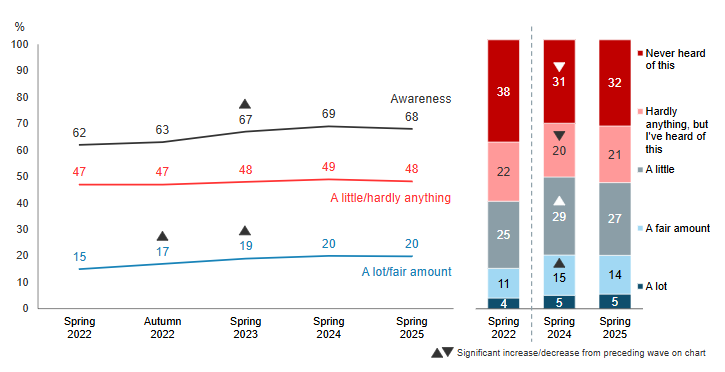
In addition, local residents are concerned about the impact of construction works on soil and natural habitat. Since the pipeline will be put underground, soil disruption is inevitable. The project developer is committed to restoring the land to its original condition, but the lack of trust is triggering opposition to any disturbances perceived as a critical risk to land and surrounding natural spaces. Potentially, such concerns could be used to reinforce other arguments, which are associated with the perceived adverse economic effects of the Peak Cluster.
Local businesses and property
Higher insurance rates, property value depreciation along the pipeline route, and reduced tourist inflow are among key issues raised by the local residents. The pipeline is not their sole concern. In the case of Wirral, the community is also opposed to the onshore CO2 compression facility, which could have a 50-meter stack structure, according to several reports. Small and medium business owners are concerned about the visual impact of the stack structure that could deteriorate the local landscape, potentially making Wirral less attractive for tourists.
Interestingly, the locals are not modern-day Luddites that oppose any technological advancements. In fact, Ørsted’s Burbo Bank Offshore Wind Farm has been operating off the Wirral coast for almost two decades as well as RWE’s Gwynt y Môr wind farm, commissioned 18 km from Wirral in 2015. Those are likely to have significant visual impact, and yet these wind farms are not part of the problem for the local stakeholders. Moreover, local authorities seem to be proud of Wirral being at the forefront of renewable energy development. The industry’s social license to operate seems to be strong, and the carbon capture and storage sector is yet to bolster its own over the near-to-medium term, which is likely to reduce the risk of public position going forward.